Powered by Theralight 360® Full-Body Red & Near-Infrared Light Therapy
Every day, your body performs millions of complex processes to repair tissue, produce energy, adapt to physical demands, and maintain optimal health. At the center of these processes are your cells—and the tiny structures inside them called mitochondria.
RESTORE is the third and final step of the Superhuman Protocol™, featuring full-body photobiomodulation (PBM) using the advanced Theralight 360®. This relaxing, non-invasive wellness experience uses therapeutic red and near-infrared light to support healthy mitochondrial function, cellular energy production, recovery, and overall well-being.
Whether your goal is to recover after exercise, maintain an active lifestyle, optimize performance, or invest in healthy aging, RESTORE is designed to complement your body's natural ability to repair, recover, and thrive.
Prepare. Fuel. Recover.
Experience the Complete Superhuman Protocol™
Light is essential to life.
This process is called photobiomodulation (PBM).
Unlike ultraviolet (UV) light, which can damage skin, therapeutic red and near-infrared light are non-ionizing wavelengths that have been investigated for their ability to support normal cellular function.
Scientists continue exploring how these wavelengths influence healthy mitochondrial activity, ATP production, cellular signaling, circulation, tissue health, recovery, and overall wellness.
What is Photobiomodulation?
Rather than masking symptoms or introducing medications, PBM is designed to support the body's own biological processes.
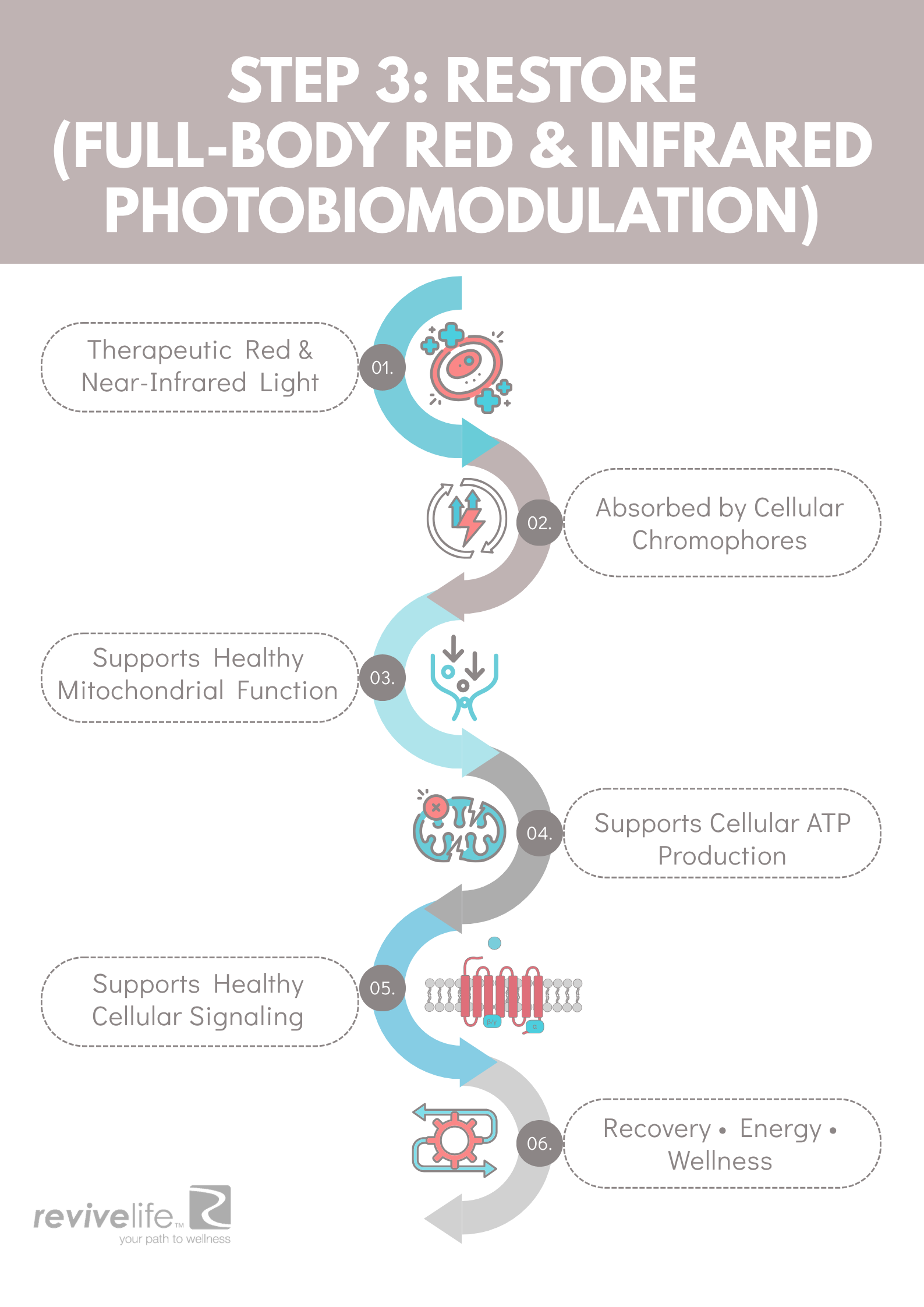
Researchers believe therapeutic light is absorbed by cellular structures within the mitochondria, where it may help support healthy energy production and cellular communication.
Because nearly every cell in the body depends on healthy mitochondrial function, photobiomodulation has become one of the most actively studied light-based wellness technologies available today.
RESTOREprovides this therapy as a comfortable, full-body experience with no needles, medications, or downtime.


Meet the Theralight 360®
Unlike small handheld devices designed to treat isolated areas, the Theralight 360® surrounds the body with therapeutic red and near-infrared light during a single session.
Its full-body design allows for broad light exposure in a comfortable, relaxing environment, making it easy to incorporate into your wellness routine.
The system combines multiple clinically relevant wavelengths of red and near-infrared light to provide comprehensive photobiomodulation throughout the body. Researchers continue studying how different wavelengths interact with healthy tissues and contribute to normal cellular processes.
For our clients, what matters most is simple: a comfortable, efficient, full-body experience designed to support recovery, resilience, and long-term wellness.
Why We Chose Full-Body Photobiomodulation
We chose a full-body approach because wellness doesn't happen one body part at a time.
Your muscles, skin, nervous system, circulatory system, and connective tissues work together as one integrated system. A full-body session reflects that same philosophy, delivering therapeutic light across the body in a single relaxing experience.
Current research into whole-body photobiomodulation continues to grow, with investigators exploring its potential role in supporting recovery, exercise physiology, sleep quality, skin health, healthy aging, and overall wellness.
At Revivelife, we believe in combining the best available evidence with technologies designed to support your body's natural physiology—not replace it.
How RESTORE Works
RESTORE uses photobiomodulation (PBM)—therapeutic red and near-infrared light—to support the body's natural cellular processes.
Researchers continue investigating how these wavelengths interact with healthy cells and influence mitochondrial function, cellular signaling, and energy production. (PMID: 28070154, 28748217)
Rather than forcing a biological response, RESTORE is designed to support the body's own physiology. The goal is to help healthy cells perform the work they are naturally designed to do. (PMID: 28070154)
What to Expect
Whether this is your first experience with photobiomodulation or you're incorporating it into your regular wellness routine, our team will guide you through every step.
RESTORE is a non-invasive wellness service that requires no needles, medications, or downtime, making it easy to fit into your lifestyle.
When you arrive, one of our wellness specialists will review your goals, answer any questions, and explain what to expect during your visit.
You'll receive protective eyewear before entering the Theralight 360®.
For optimal light exposure, comfortable clothing or minimal clothing is generally recommended while always maintaining your privacy and comfort.
The experience is:
Many clients include RESTORE as part of a broader wellness routine that also includes regular exercise, balanced nutrition, quality sleep, hydration, and the complete Superhuman Protocol™.
Training challenges your body. Recovery helps it adapt.
Photobiomodulation has been widely studied in sports medicine for its potential role in supporting muscle recovery, exercise physiology, and healthy mitochondrial function (PMID: 30934744).
Whether you're preparing for your next competition or simply staying active, RESTORE is designed to complement—not replace—smart training, nutrition, hydration, and sleep.
RESTORE provides an opportunity to slow down, recharge, and support your body's natural physiology in a calm, restorative environment.
RESTORE complements a proactive lifestyle focused on movement, nutrition, restorative sleep, stress management, and preventive wellness.
The RESTORE Experience
Whether this is your first experience with photobiomodulation or you're incorporating it into your regular wellness routine, our team will guide you through every step.
RESTORE is a non-invasive wellness service that requires no needles, medications, or downtime, making it easy to fit into your lifestyle.

Frequently Asked Questions
Tanning beds use ultraviolet (UV) light, which can damage the skin. RESTORE uses therapeutic red and near-infrared light. These wavelengths contain no UV radiation and have been extensively studied for their interaction with healthy cells.
Most clients find RESTORE comfortable and relaxing. There are no needles, medications, or invasive procedures involved.
RESTORE was selected as the final step of the Superhuman Protocol™ because it complements PRIME and OXYGENATE. Together, the three therapies support healthy cellular communication, oxygen utilization, mitochondrial function, and recovery.
• PRIME helps prepare healthy cellular communication.
• OXYGENATE supports oxygen utilization and cellular energy production.
• RESTORE supports healthy mitochondrial function and the body's natural recovery processes.
Together, they create a comprehensive wellness experience designed to help you Prepare. Fuel. Recover.
Complete Your Superhuman Protocol™
Three Therapies. One Integrated Wellness Experience.
At Revivelife Longevity Lounge, we believe the best results come from supporting the body's natural physiology through a comprehensive approach—not a single therapy.
The Superhuman Protocol™ combines three evidence-informed technologies that work together to support healthy cellular communication, oxygen utilization, mitochondrial function, and recovery.
Each therapy serves a unique purpose.
Together, they create one complete wellness experience.
Why Clients Choose Revivelife
The following peer-reviewed publications represent foundational and contemporary research in photobiomodulation.
Mechanisms of Photobiomodulation Hamblin MR.
Mechanisms and Applications of the Anti-inflammatory Effects of Photobiomodulation.
PMID: 28070154
Hamblin MR.
Mechanisms and Mitochondrial Pathways in Photobiomodulation.
PMID: 28748217
Chung H, et al.
The Nuts and Bolts of Low-Level Laser (Light) Therapy.
PMID: 22474485
Exercise & Recovery
Ferraresi C, et al.
Photobiomodulation Therapy in Skeletal Muscle: From Basic Science to Clinical Applications.
PMID: 30934744
Skin & Tissue Health
Avci P, et al.
Low-Level Laser (Light) Therapy for Treatment of the Skin.
PMID: 23860798
Whole-Body Photobiomodulation
Systematic Review of Whole-Body
Photobiomodulation.
PMID: 39883205 Umbrella Review of Clinical Photobiomodulation Evidence. PMID: 40770824
Begin Your Journey to Better Recovery
Your body is designed to adapt, recover, and thrive.
At Revivelife Longevity Lounge, we've created an evidence-informed wellness experience that supports those
natural processes through the Superhuman Protocol™.
Whether your goal is to enhance recovery, optimize performance,
increase resilience, or invest in healthy aging, our team is here to help you build a personalized wellness routine focused on long-term vitality.
Prepare. Fuel. Recover.
Experience the Complete Superhuman Protocol™
Contact Us
Reach Out Today
Get in touch with us through the form below, and our team will respond promptly.
The information provided on this page is intended for educational and informational purposes only and should not be considered medical advice.
RESTORE, featuring full-body photobiomodulation using the Theralight 360®, is offered as a wellness service designed to support healthy physiological function, mitochondrial health, cellular energy production, recovery, skin wellness, and overall well-being.
It is not intended to diagnose, treat, cure, or prevent any disease or medical condition. Photobiomodulation has been extensively studied across numerous areas of medicine and wellness. While many findings are encouraging, research is ongoing, treatment protocols vary, and individual responses may differ.
RESTORE is intended to complement—not replace—a healthy lifestyle that includes regular physical activity, balanced nutrition, restorative sleep, stress management, and appropriate medical care.
If you are pregnant, have a medical condition, are taking photosensitizing medications, or are under the care of a healthcare professional, please consult your healthcare provider before participating.