

The Science of 03 - OXYGENATE™
EWOT • OXYGEN-ENRICHED EXERCISE
OXYGENATE™ combines controlled exercise with oxygen-enriched air to increase the oxygen available to breathe during movement.
Research into hyperoxic exercise has investigated how increased oxygen availability may influence arterial and tissue oxygenation, exercise capacity, endurance and performance. [1–3]
Move. Breathe. Oxygenate.
Your Body Uses Oxygen to Produce Energy.
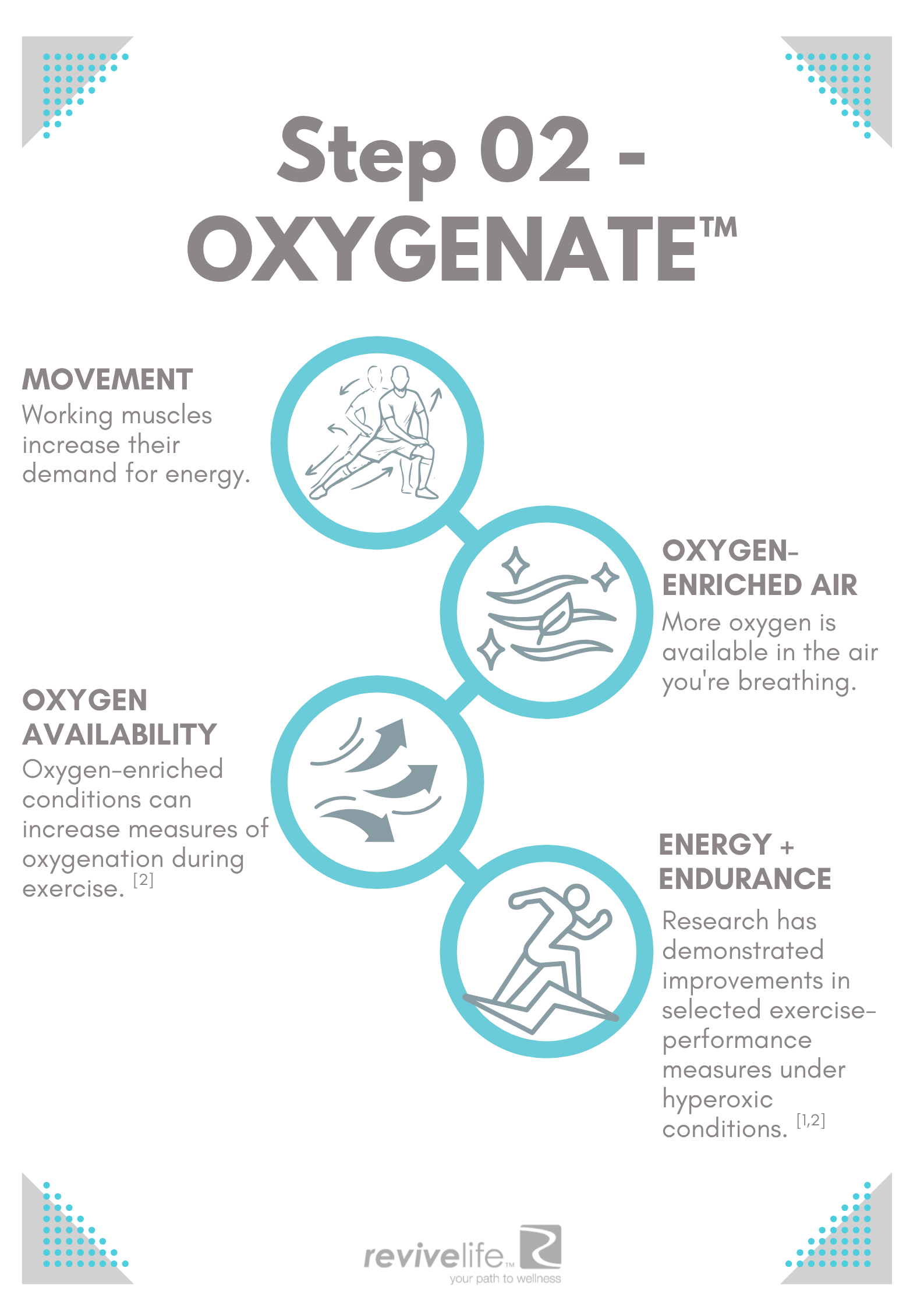
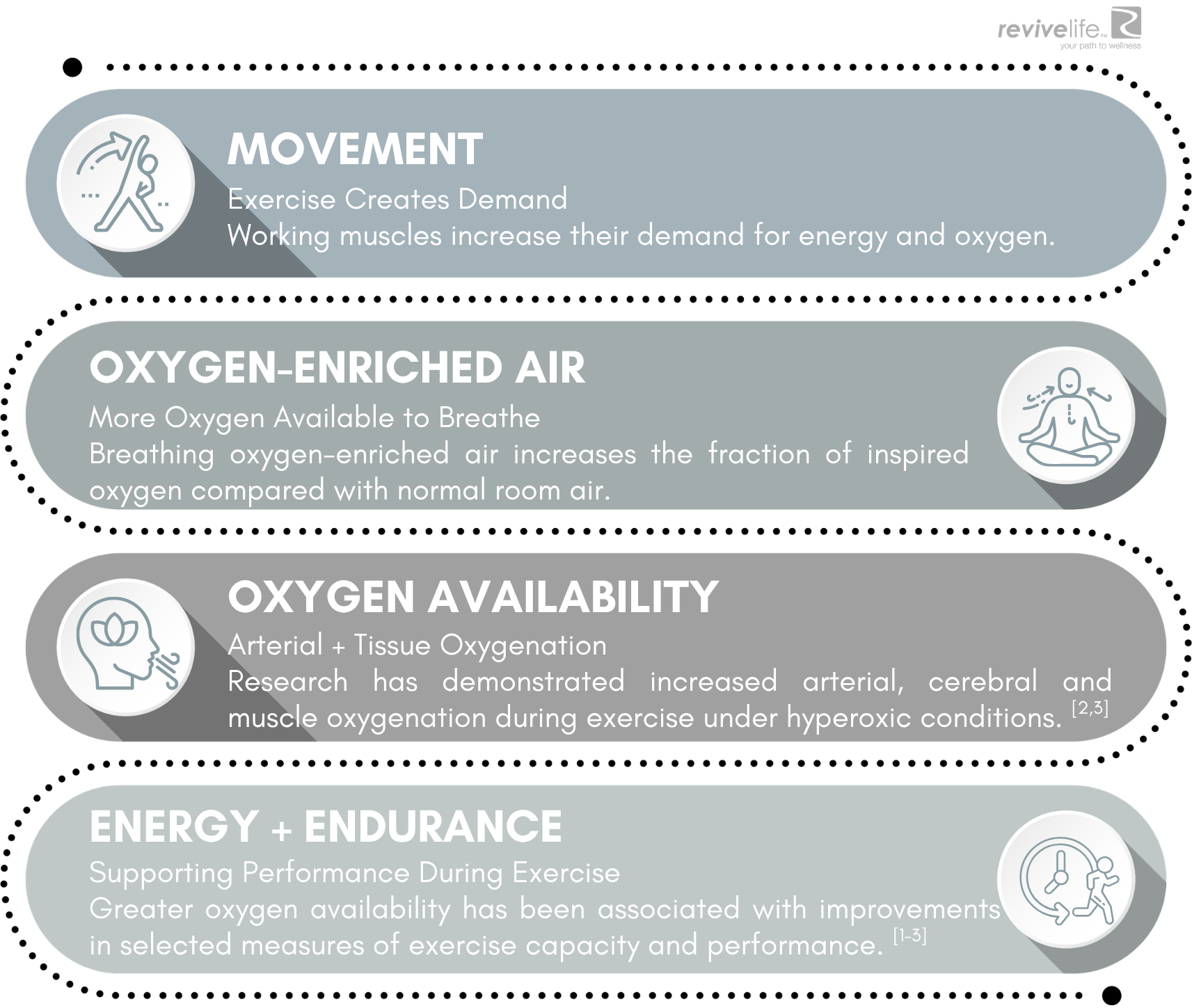
During exercise, working muscles need more energy.
Your respiratory and cardiovascular systems respond by increasing breathing and circulation to help supply oxygen to working tissues.
Inside your cells, oxygen plays a fundamental role in aerobic energy production within the mitochondria.
As exercise intensity rises, so does the body's demand for oxygen.
Your respiratory and cardiovascular systems respond by increasing breathing and circulation to help supply oxygen to working tissues.
Inside your cells, oxygen plays a fundamental role in aerobic energy production within the mitochondria.
As exercise intensity rises, so does the body's demand for oxygen.
Movement creates demand. Oxygen helps support the energy required to meet it. That's the basic physiological principle behind OXYGENATE™.
From the Lungs to Working Tissue.
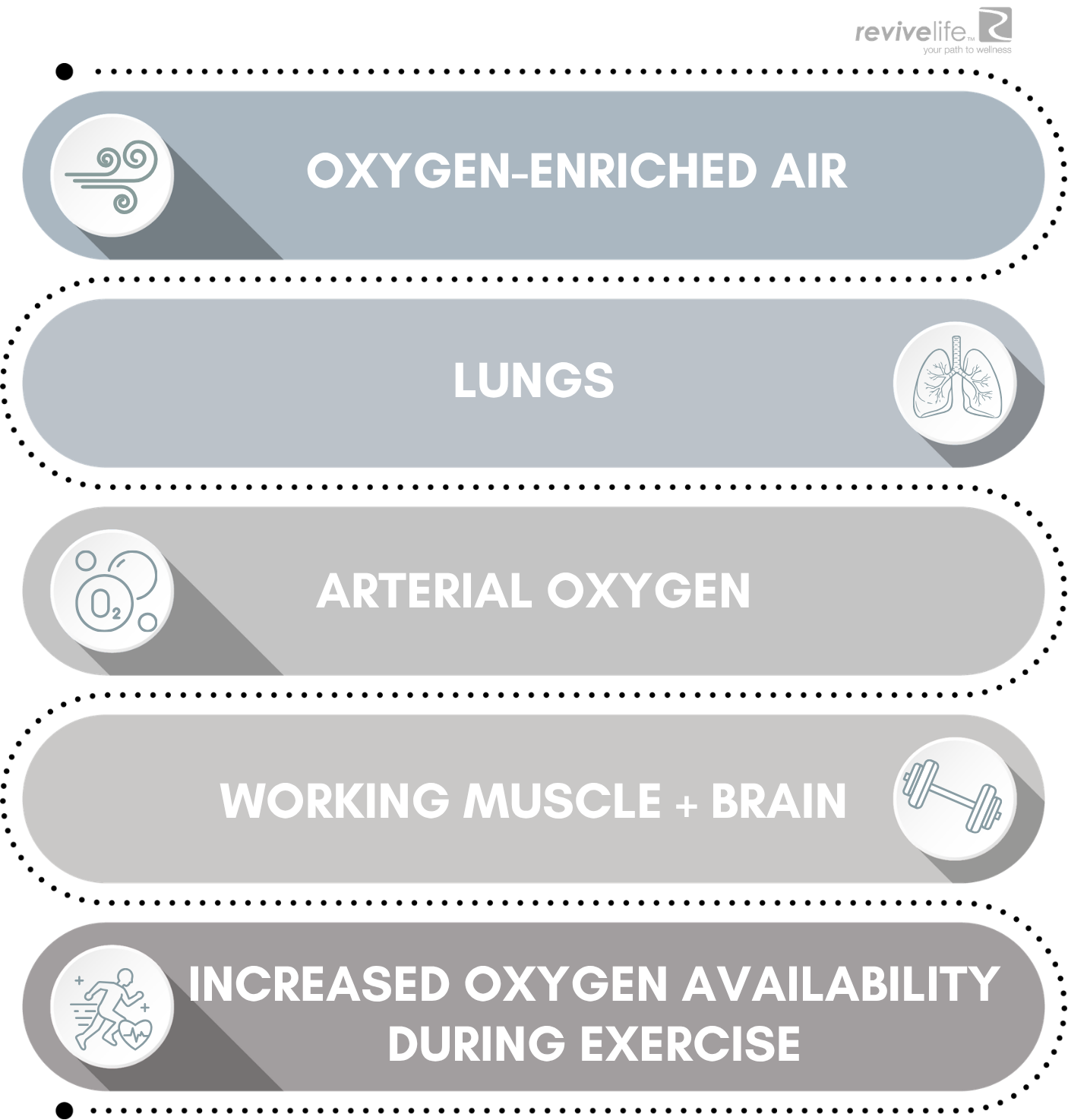
Breathing oxygen-enriched air increases the partial pressure of oxygen in the lungs and arterial blood.
Because hemoglobin is already highly saturated in healthy people breathing room air at sea level, supplemental oxygen does not simply mean dramatically “more oxygen on hemoglobin.”
Instead, hyperoxia can increase arterial oxygen tension and dissolved oxygen, while studies during exercise have also demonstrated increased measures of muscle and cerebral tissue oxygenation. [2,3]
Because hemoglobin is already highly saturated in healthy people breathing room air at sea level, supplemental oxygen does not simply mean dramatically “more oxygen on hemoglobin.”
Instead, hyperoxia can increase arterial oxygen tension and dissolved oxygen, while studies during exercise have also demonstrated increased measures of muscle and cerebral tissue oxygenation. [2,3]
The OXYGENATE™ story isn't simply “more oxygen in your blood.”
It's about making more oxygen available during physical activity, when working tissues are actively using oxygen.
It's about making more oxygen available during physical activity, when working tissues are actively using oxygen.
THE SCIENCE, SIMPLIFIED
More Oxygen Available During Movement.
Normal room air contains approximately 21% oxygen.
During OXYGENATE™, you perform controlled exercise while breathing oxygen-enriched air.
Studies examining hyperoxia during exercise have demonstrated increased measures of arterial, cerebral and skeletal-muscle oxygenation, along with improvements in selected measures of exercise capacity and performance. [1–3]
Normal room air contains approximately 21% oxygen.
During OXYGENATE™, you perform controlled exercise while breathing oxygen-enriched air.
Studies examining hyperoxia during exercise have demonstrated increased measures of arterial, cerebral and skeletal-muscle oxygenation, along with improvements in selected measures of exercise capacity and performance. [1–3]
OXYGENATE™ brings movement + oxygen-enriched air together in one active experience.
MOVEMENT → OXYGEN AVAILABILITY → PERFORMANCE
Breathe. Move. Oxygenate.
MOVEMENT → OXYGEN AVAILABILITY → PERFORMANCE
Breathe. Move. Oxygenate.
Frequently Asked Questions
EWOT stands for Exercise With Oxygen Therapy and combines physical movement with breathing oxygen-enriched air in a non-pressurized environment.
During exercise, working muscles increase their demand for energy and oxygen. EWOT increases the concentration of oxygen available to breathe while you exercise. Research into hyperoxic exercise has demonstrated increased measures of arterial and tissue oxygenation and improvements in selected measures of exercise capacity. [1–3]
Breathing oxygen-enriched air increases inspired oxygen and arterial oxygen tension. Research has also demonstrated increased cerebral and muscle oxygenation during exercise under hyperoxic conditions. [2,3]
Research into acute hyperoxic exercise has reported improvements in endurance and selected measures of exercise performance. Results vary according to oxygen concentration, exercise protocol and individual. [1–4]
Studies of hyperoxia have reported changes in HRV and parasympathetic cardiac influence under some conditions. [5,6] This does not establish that every oxygen protocol—or OXYGENATE™ specifically—will improve HRV.
The vagus nerve contributes to parasympathetic regulation of the heart. Hyperoxia research has reported changes consistent with altered parasympathetic cardiac influence, but this should not be interpreted as evidence that OXYGENATE™ directly stimulates the vagus nerve. [5,6]
Oxygen-enriched breathing should not simply be described as increasing circulation. Acute hyperoxia can cause vascular and hemodynamic changes, including vasoconstriction under some conditions. [7]
For OXYGENATE™, the stronger evidence-based focus is increased oxygen availability and tissue oxygenation during exercise.
For OXYGENATE™, the stronger evidence-based focus is increased oxygen availability and tissue oxygenation during exercise.
ENERGY • ENDURANCE • PERFORMANCE
Put Oxygen Into Motion.
Explore the science behind OXYGENATE™, then experience it as a dedicated 30-minute EWOT experience or as the focused 15-minute ACTIVATE stage of Superhuman™.
Breathe. Move. Oxygenate.
EVIDENCE-INFORMED WELLNESS DISCLAIMER
This page is intended for educational and informational purposes and is not medical advice, diagnosis or treatment.
Photobiomodulation is an active area of scientific research. Findings vary according to wavelength, dose, treatment area, device, population and outcome, and findings from localized PBM research should not automatically be assumed to apply to whole-body PBM.
RENEW™ is offered as a wellness experience designed to complement a healthy lifestyle and recovery routine.
This page is intended for educational and informational purposes and is not medical advice, diagnosis or treatment.
Photobiomodulation is an active area of scientific research. Findings vary according to wavelength, dose, treatment area, device, population and outcome, and findings from localized PBM research should not automatically be assumed to apply to whole-body PBM.
RENEW™ is offered as a wellness experience designed to complement a healthy lifestyle and recovery routine.
[1] Mallette MM, Stewart DG, Cheung SS. The Effects of Hyperoxia on Sea-Level Exercise Performance, Training, and Recovery: A Meta-Analysis. Sports Med. 2018;48(1):153–175. PMID: 28975517. DOI: 10.1007/s40279-017-0791-2. Meta-analysis of 51 manuscripts examining acute performance, training and recovery under hyperoxic conditions. PMID 28975517
[2] Ulrich S, Hasler ED, Müller-Mottet S, et al. Mechanisms of Improved Exercise Performance under Hyperoxia. Respiration. 2017;93(2):90–98. PMID: 28068656. DOI: 10.1159/000453620. In 32 healthy adults, 50% oxygen during cycling increased maximal workload and endurance and improved arterial, cerebral and muscle oxygenation compared with room air. PMID 28068656
[3] Hasler ED, et al. Effect of hypoxia and hyperoxia on exercise performance in healthy individuals and in patients with pulmonary hypertension: a systematic review. PMID: 28775065. DOI: 10.1152/japplphysiol.00186.2017. The review found improved maximal and submaximal exercise performance under oxygen-enriched conditions, associated with improved arterial, muscle and cerebral oxygenation. PMID 28775065
[4] Cardinale DA, Ekblom B. Hyperoxia for performance and training. J Sports Sci. 2018;36(13):1515–1522. PMID: 29115912. DOI: 10.1080/02640414.2017.1398893. Review of the use of hyperoxia during athletic training and performance, including oxygen transport, work tolerance and power output. PMID 29115912
[5] Lund VE, Kentala E, Scheinin H, et al. Heart rate variability in healthy volunteers during normobaric and hyperbaric hyperoxia. Acta Physiol Scand. 1999;167(1):29–35. PMID: 10519974. DOI: 10.1046/j.1365-201x.1999.00581.x. The study examined HRV during oxygen exposure and reported changes suggesting increased parasympathetic influence as oxygen partial pressure increased. PMID 10519974
[6] Gole Y, et al. Hyperoxia-induced alterations in cardiovascular function and autonomic control during return to normoxic breathing. Eur J Appl Physiol. 2011;111(6):937–946. PMID: 21069379. The study examined cardiovascular and autonomic responses to 100% oxygen in healthy volunteers, including HRV changes. PMID 21069379
[7] Smit B, Smulders YM, van der Wouden JC, Oudemans-van Straaten HM, Spoelstra-de Man AME. Hemodynamic effects of acute hyperoxia: systematic review and meta-analysis. Crit Care. 2018;22:45. PMID: 29477145. PMCID: PMC6389225. DOI: 10.1186/s13054-018-1968-2. Systematic review examining the cardiovascular and hemodynamic effects of acute hyperoxia. PMID 29477145
[8] Effects of normobaric hyperoxic recovery after exercise on subsequent performance: a systematic review and meta-analysis with secondary physiological outcomes. Recent systematic review examining hyperoxia as a post-exercise recovery intervention and subsequent performance.
[2] Ulrich S, Hasler ED, Müller-Mottet S, et al. Mechanisms of Improved Exercise Performance under Hyperoxia. Respiration. 2017;93(2):90–98. PMID: 28068656. DOI: 10.1159/000453620. In 32 healthy adults, 50% oxygen during cycling increased maximal workload and endurance and improved arterial, cerebral and muscle oxygenation compared with room air. PMID 28068656
[3] Hasler ED, et al. Effect of hypoxia and hyperoxia on exercise performance in healthy individuals and in patients with pulmonary hypertension: a systematic review. PMID: 28775065. DOI: 10.1152/japplphysiol.00186.2017. The review found improved maximal and submaximal exercise performance under oxygen-enriched conditions, associated with improved arterial, muscle and cerebral oxygenation. PMID 28775065
[4] Cardinale DA, Ekblom B. Hyperoxia for performance and training. J Sports Sci. 2018;36(13):1515–1522. PMID: 29115912. DOI: 10.1080/02640414.2017.1398893. Review of the use of hyperoxia during athletic training and performance, including oxygen transport, work tolerance and power output. PMID 29115912
[5] Lund VE, Kentala E, Scheinin H, et al. Heart rate variability in healthy volunteers during normobaric and hyperbaric hyperoxia. Acta Physiol Scand. 1999;167(1):29–35. PMID: 10519974. DOI: 10.1046/j.1365-201x.1999.00581.x. The study examined HRV during oxygen exposure and reported changes suggesting increased parasympathetic influence as oxygen partial pressure increased. PMID 10519974
[6] Gole Y, et al. Hyperoxia-induced alterations in cardiovascular function and autonomic control during return to normoxic breathing. Eur J Appl Physiol. 2011;111(6):937–946. PMID: 21069379. The study examined cardiovascular and autonomic responses to 100% oxygen in healthy volunteers, including HRV changes. PMID 21069379
[7] Smit B, Smulders YM, van der Wouden JC, Oudemans-van Straaten HM, Spoelstra-de Man AME. Hemodynamic effects of acute hyperoxia: systematic review and meta-analysis. Crit Care. 2018;22:45. PMID: 29477145. PMCID: PMC6389225. DOI: 10.1186/s13054-018-1968-2. Systematic review examining the cardiovascular and hemodynamic effects of acute hyperoxia. PMID 29477145
[8] Effects of normobaric hyperoxic recovery after exercise on subsequent performance: a systematic review and meta-analysis with secondary physiological outcomes. Recent systematic review examining hyperoxia as a post-exercise recovery intervention and subsequent performance.